Webinar Recap: Math, Mindset, and Belonging
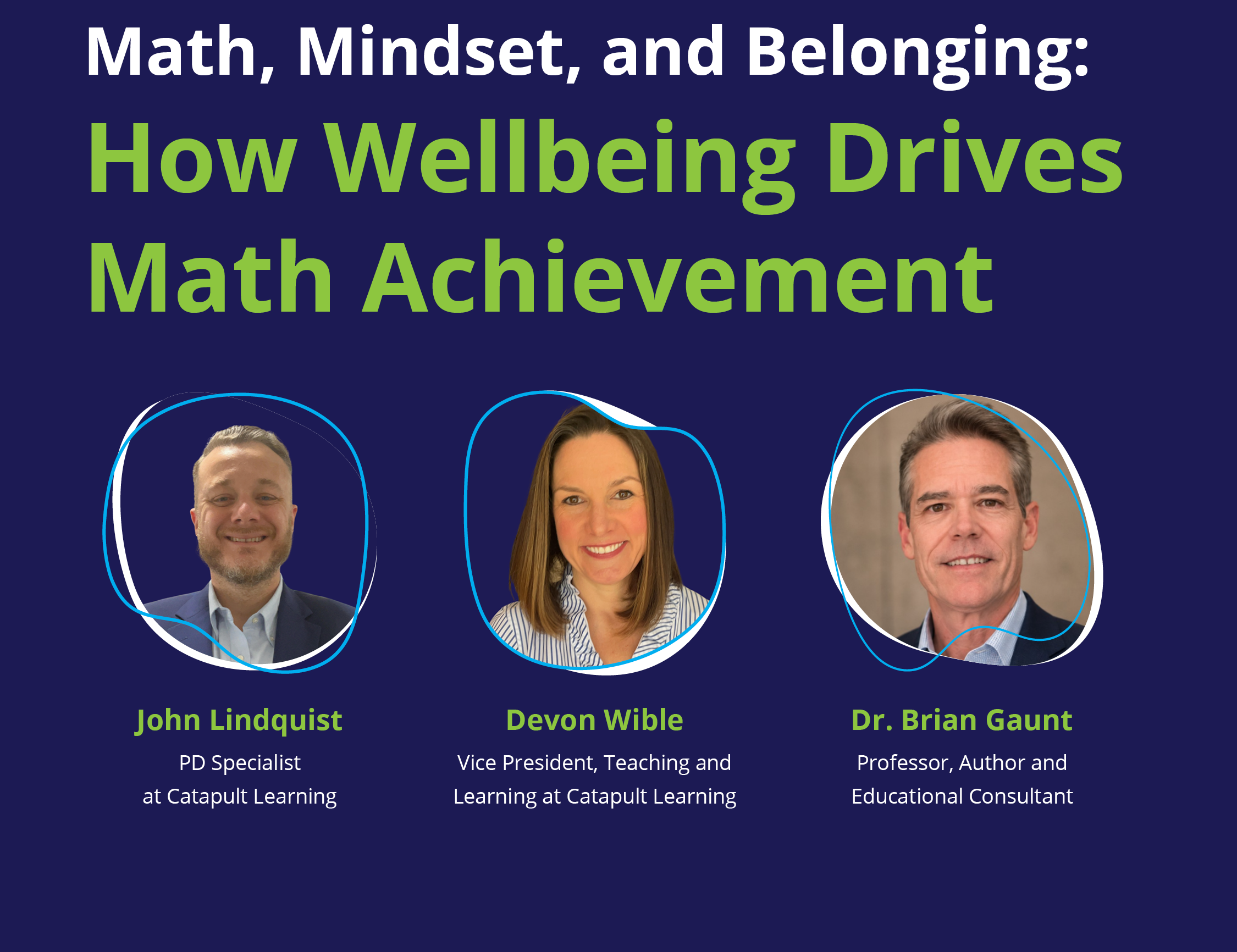
Recap of “Math, Mindset, and Belonging: How Wellbeing Drives Math Achievement,” with Brian Gaunt, John Lindquist, and Britt Shurley. Watch the full recording here.
The national numbers set the stakes. On the 2024 NAEP, 39% of fourth graders scored at or above Proficient in math; by eighth grade, that drops to 28%. Math scores still haven’t recovered to 2019 levels. And across OECD countries, 39% of 15-year-olds say they get very nervous doing math problems, up from 31% a decade earlier.
The webinar’s argument was that those two trends are connected, and that leaders can do something about the second one. Here’s what stood out.
“This isn’t a genetics problem.” Brian Gaunt, a school psychologist by training, walked through an ecological view of math identity: a student’s relationship with math is shaped by self-talk, family (“I don’t know this new math stuff”), peers, and, most of all, what they observe in classrooms. Kids notice who gets called on, whose strategies get credited, and how teachers react to mistakes. The question for every building: do students experience difficulty in math as a normal part of learning, or as evidence they should give up?
Feedback is where learning happens, and it’s unevenly distributed. If the only students getting a dense cycle of feedback are the ones who call out answers, everyone else learns that “a successful math person is someone who is fast.” Brian’s counter: give students explicit permission to say “this isn’t making sense, show me another way,” and treat that as feedback for the instructor. Recognition means acknowledging the reasoning and the asking, not empty praise.
Struggle is the carrot, not the problem. Making work easier reduces frustration, but repeated patterns of easy work send a message: I don’t think you can handle the hard stuff. Students need work in their zone of proximal development, plus data sensitive enough to show small growth. Brian’s analogy: a scale that only measures in 20-pound increments will never show you the two pounds you lost.
Make the thinking visible. Britt walked through 18 × 5 three ways, including ten groups of five, twice, minus two groups. The point for teachers: name the learning, give one step at a time, and reward the thinking (“you worked so hard at understanding how to think about these problems”) rather than speed or the right answer.
Leaders set the conditions. John Lindquist’s message to principals: you don’t have to be the math expert. Your lever is schedules, relationships, expectations, and access. Who gets recognized? Who gets recommended for advanced courses? Which subgroups are routinely pulled out, late, or unable to stay for after-school tutoring? Do your interventionists, MLL specialists, and classroom teachers have time to align on language and representations, so a student isn’t hearing a concept explained three different ways?
A 30-day plan. Pick one grade-level team. Schedule three 20-minute classroom visits. Talk to five students: What happens when you get stuck? When has someone used your idea? What can you do now that you couldn’t before? Bring the evidence back to the team, pick one routine to strengthen, assign an owner, and set a review date.
Where to start
All three speakers kept returning to coherence: the same language and representations across core instruction, intervention, and tutoring, with a team that revisits the evidence on a schedule. That’s an MTSS question before it’s a math question. Our short self-assessment helps you see where your system is strong and where the connections are thin.