Webinar Recap: Making MTSS Work
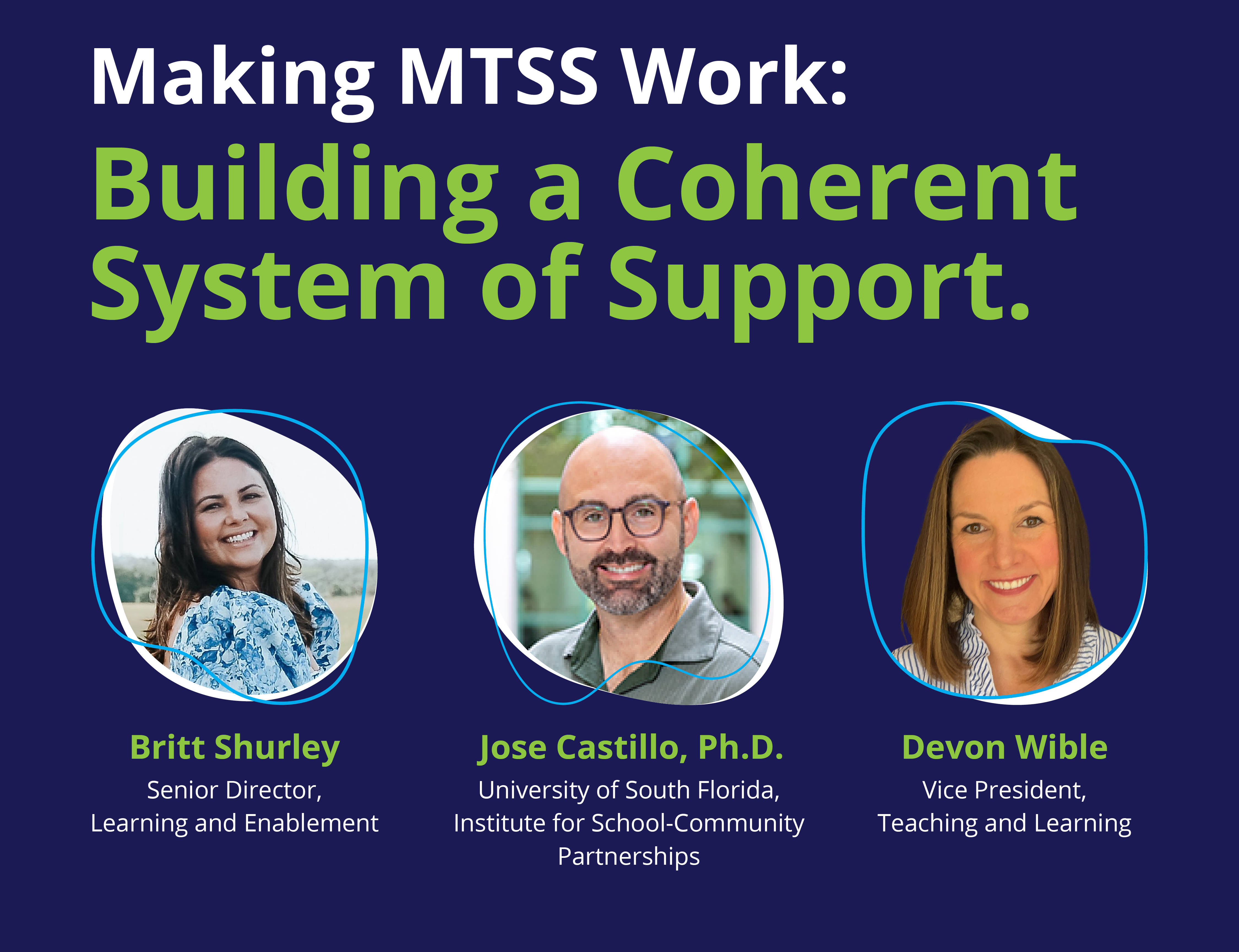
Recap of “Making MTSS Work: Building a Coherent System of Support,” with Dr. Jose Castillo (USF), Devon Wible, and Britt Shurley. Watch the full recording below.
When we polled the district and school leaders on our October 27th webinar about which element of a coherent MTSS felt least established, roughly 60% said the same thing: coordinated decisions. Not shared purpose. Not a lack of programs. The hard part is getting the pieces you already have to work together.
That was the throughline of the conversation.
Here are the takeaways worth bringing back to your leadership team. We also invite you to watch the full webinar here.
Coherence is a system that makes sense to the student. Dr. Castillo’s definition was the simplest: “a system that makes sense and the different parts complement each other, rather than work against each other or create confusion.” Britt’s kindergartner illustrated the opposite. One teacher called the silent E the “phantom E,” another called it “magic E,” and he spent his energy deciphering the difference instead of learning to read. Multiply that across assessments, interventions, tutoring, and PD, and you have a district full of good initiatives that never compound.
Start with purpose, not compliance. Many districts first meet MTSS through special education eligibility. That’s legitimate, but, as Dr. Castillo put it, “when we design our MTSS with that purpose in mind, we often get compliance behaviors.” A shared purpose sounds different: organizing finite resources so all students meet expectations, and adjusting the tiers based on who walks in the door. One principal he worked with made that shift by writing core beliefs on index cards and having every grade-level team rate and discuss them. What had looked like resistance turned out to be staff pursuing a different purpose than their leader.
Your triangle probably isn’t a triangle. In our second poll, the most common answers were “upside down” and “bloated.” Nobody did anything wrong; that’s how students arrive. But the shape should drive how you map resources. If the bottom is large, you can’t serve everyone individually. You have to strengthen what every student gets at Tier 1 while keeping Tier 2 and 3 supports from trailing off.
Define the goal before you look at the data. Every action needs an owner, the specific evidence you’ll review, and a date you’ll come back. Decide up front: “If we do X, then Y will happen.” Check Y in four to six weeks, and again at eight. Otherwise, in Devon’s words, you get “data creep.”
Refine before you add. Devon’s resource-mapping scenario hit home: a reading intervention and a tutoring program serving the same students with the same need, planned and reviewed by teams that never talk. The fix usually isn’t cutting a support. It’s three questions: What do we have? Who does it serve? How do they connect? That third one, Devon noted, “is the key question that often doesn’t get asked.”
Expect the roller coaster. Implementation dips, recovers, and dips again. Leaders who name that pattern with their teams up front are the ones who reach full implementation.
Where to start
Every speaker recommended the same first step: honestly assess where your system is strong and where it’s thin, using a rubric that lets district leaders coordinate across schools while leaving each building its autonomy. We’ve condensed the longer state tools into a short self-assessment you can complete in minutes.